
Why Do So Many Neuropathy Patients Have Poor Circulation?
The Drugless Doctors Approach to Evaluating Circulation Dysfunction, Microcirculation & Peripheral Neuropathy
Introduction
Circulation problems are commonly associated with neuropathy symptoms, yet many individuals are never fully evaluated for impaired microcirculation and oxygen delivery.
Many patients experiencing tingling, burning, numbness, cold feet, delayed healing, balance instability, or pins-and-needles sensations may have underlying circulation dysfunction contributing to nerve irritation.
Nerves are highly dependent upon healthy blood flow, oxygen delivery, nutrient transport, and microcirculation. When circulation becomes impaired, nerves may become irritated, inflamed, weak, hypersensitive, or unable to properly repair themselves.
Why Circulation Is Important to Nerves
Nerves require oxygen, nutrients, glucose stability, nitric oxide activity, and healthy blood flow.
When circulation declines:
• oxygen delivery decreases
• inflammatory stress may increase
• waste products may accumulate
• tissue repair may slow
• nerve signaling may become impaired
Microcirculation & Neuropathy
Microcirculation refers to the tiny blood vessels responsible for delivering oxygen and nutrients directly into tissues and nerves.
Even when larger arteries appear relatively normal, microcirculation may still be impaired.
Reduced microcirculation may contribute to tingling, burning, numbness, delayed healing, cold feet, sensory loss, and neuropathy progression.
Nitric Oxide & Oxygen Delivery
Nitric oxide plays a major role in circulation and oxygen delivery into tissues.
Reduced nitric oxide physiology may contribute to:
• cold feet
• tingling
• burning sensations
• delayed healing
• impaired tissue recovery
• poor oxygen utilization
Inflammation & Circulation
Inflammation may impair circulation while simultaneously irritating nerves.
Inflammatory stress may:
• constrict circulation
• impair oxygen delivery
• worsen swelling
• increase nerve sensitivity
• impair healing physiology
Hemosiderin & Circulation Findings
One body signal we commonly observe in patients with impaired circulation is hemosiderin staining. Hemosiderin is a brownish discoloration often seen around the lower legs and ankles resulting from the breakdown of red blood cells leaking from stressed blood vessels.
This finding may suggest chronic venous congestion, poor circulation, inflammatory stress, and impaired vascular integrity.
Hemosiderin is rarely discussed in traditional neuropathy conversations, yet it may provide important clues regarding circulation dysfunction and tissue stress physiology.
Varicose Veins, Spider Veins & Hemorrhoids
We also observe body signals involving varicose veins, spider veins, and hemorrhoids. These findings may suggest underlying venous congestion and impaired blood flow patterns.
From a physiologic perspective, if venous return becomes impaired, arterial circulation may also become compromised. Efficient circulation depends upon both healthy arterial delivery and effective venous return.
Varicose veins should not always be viewed as merely a cosmetic issue. In many individuals, they may reflect chronic venous congestion, impaired vascular integrity, inflammatory stress, or circulatory overload patterns.
The liver also plays a major role in circulation physiology, inflammatory regulation, detoxification pathways, and protein production. When liver congestion or fatty liver physiology develops, vascular congestion patterns may become more noticeable throughout the body.
In some patients, I may recommend standing AP and lateral lumbar or pelvic imaging to evaluate structural anatomy and liver size patterns. The liver is located on the right side of the abdomen and normally should not extend significantly below the lower rib margin.
We have observed patients demonstrating substantial liver enlargement patterns together with circulation dysfunction, abdominal congestion, inflammatory stress, and venous pooling patterns.
As circulation, inflammation, metabolic physiology, and nutritional stability improve, reductions in congestion patterns may also occur.
How We Assess Circulation & Neuropathy
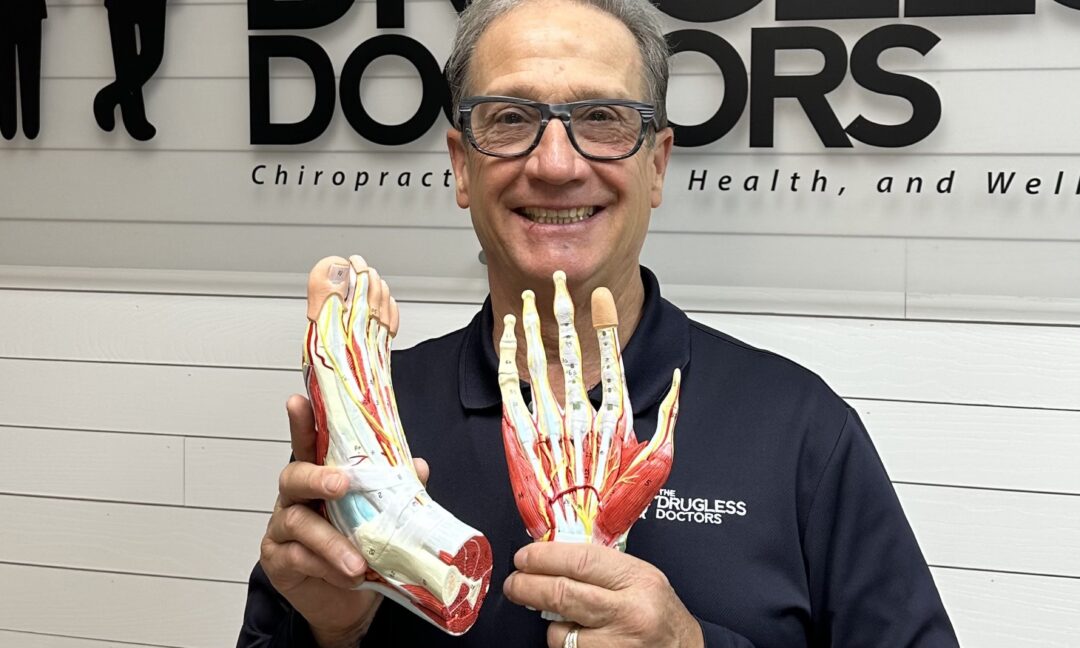
In the office, we complete a comprehensive sensory and circulation evaluation utilizing observation, circulation assessment, metabolic review, and neurologic pattern recognition.
Observation is extremely important. Gait patterns, posture, skin tone, toenail quality, toe hair distribution, swelling patterns, and tissue coloration often provide important clues regarding circulation and nerve health.
We utilize thermographic imaging of the hands and feet to evaluate circulation patterns and temperature distribution. Reduced circulation often demonstrates cooler or bluish appearing hands and toes.
We also assess pedal pulses and evaluate nitric oxide physiology using nitric oxide test strips.
Another assessment tool utilized in the practice is a digital Heart Sound Recorder (HSR), which may provide additional insight into cardiovascular physiology and circulation efficiency.
The Drugless Doctors Three-Tier Supportive Strategy
The supportive strategy utilized in the practice focuses on:
• biochemical support
• biovascular circulation support
• biostructural stabilization
The objective is supporting circulation, nitric oxide physiology, tissue oxygenation, mitochondrial activity, metabolic stability, and nerve recovery physiology.
One of the foundational supportive modalities utilized in the practice is FDA-cleared photobiomodulation therapy designed to support circulation and microcirculation involving sensory tissues.
When Further Evaluation May Be Appropriate
If you are experiencing:
• tingling
• numbness
• burning feet
• cold hands or feet
• balance instability
• delayed healing
• circulation changes
• sensory decline
These findings may suggest impaired circulation, reduced oxygen delivery, microvascular stress, or early neuropathy physiology.
A comprehensive circulation and neuropathy evaluation may help identify physiologic stress patterns contributing to nerve irritation, circulation dysfunction, and impaired recovery physiology.
The earlier circulation dysfunction and sensory loss are identified, the greater the opportunity for supportive intervention and stabilization.
Patient Summary
Circulation plays a critical role in nerve health because nerves depend heavily upon oxygen delivery, nutrient transport, nitric oxide activity, and healthy microcirculation.
When circulation becomes impaired, nerves may become irritated, inflamed, weak, or unable to properly repair themselves.
The goal is not simply symptom masking, but identifying and supporting the underlying physiologic factors contributing to circulation dysfunction, impaired oxygen delivery, inflammatory stress, and nerve irritation.
References
- Callaghan BC, Cheng HT, Stables CL, Smith AL, Feldman EL. Lancet Neurol. 2012.
- Pop-Busui R, et al. Diabetes Care. 2017.
- Ignarro LJ. Proc Natl Acad Sci USA. 1992.
- Bryan NS, Loscalzo J. Nitric Oxide and the Cardiovascular System.
- Hamblin MR. AIMS Biophys. 2017.
- Oyenihi AB, et al. Int J Mol Sci. 2015.
- Caggiati A, et al. Venous insufficiency and chronic venous disease pathophysiology. Int Angiol.
- Mayo Clinic Staff. Peripheral neuropathy symptoms and causes.
- National Institute of Neurological Disorders and Stroke (NINDS). Peripheral Neuropathy Fact Sheet.
- American Heart Association. Obesity and circulation physiology educational resources.
Schedule Your Neuropathy Appointment
Schedule an evaluation to see if neuropathy will work for you.